
OEM vs ODM vs Private Label for Air Fryer Ovens: MOQ, Tooling Cost and Who Owns the Mold
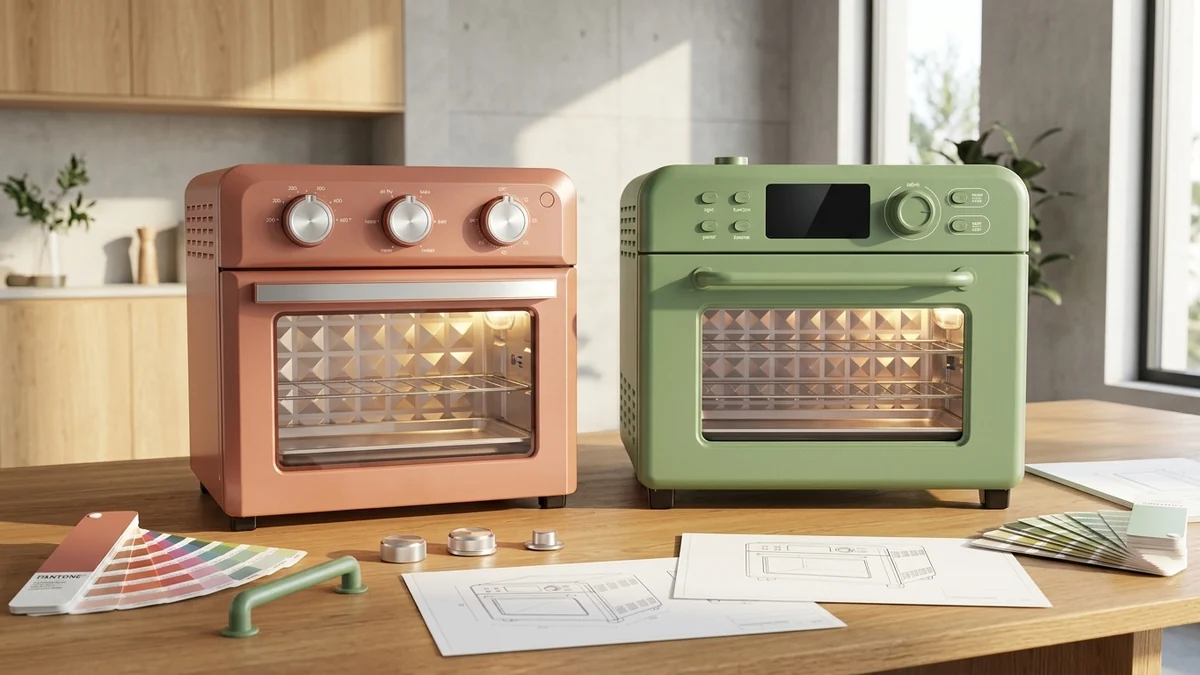
- Private label on existing tooling is the fastest route to market (500–1,000 units MOQ, zero mold fee); full ODM custom tooling requires dedicated mold investment.
- Always clarify what an MOQ covers: typically 1 model, 1 housing color, 1 voltage version, and 1 retail packaging SKU.
- Define mold ownership and exclusivity terms in writing before paying tooling deposits.
"Private label" gets used to mean three different deals, and the difference is worth tens of thousands of dollars. In one deal you are putting your logo on a factory's existing oven next month. In another you are paying for a mold that may — or may not — legally belong to you.
This guide separates OEM, ODM and private label for air fryer ovens, lays out the MOQ ladder buyers actually encounter, and shows the tooling maths and the ownership clauses that decide whether your investment stays yours.
1. Three Models, One Table
The three routes below follow the definitions used consistently across standard OEM/ODM manufacturing practice.
| Route | What you get | What you change | Typical MOQ (supplier-published) | Tooling |
|---|---|---|---|---|
| Private label (on existing tooling) | The factory's current model, your brand | Logo, color box, manual language | 200–500 units | None |
| OEM (existing mold) | A proven mold built to your spec and branding | Logo, Pantone color, packaging, presets, plug/voltage version | 500–1,000 units | None, or minor modification |
| ODM / new tooling | A model developed for you, new molds | Industrial design, cavity, controls, full spec | 1,000–3,000+ units | Custom mold required |
One category-specific warning: oven factories commonly set MOQ at 1,000 units per model even for established platforms — Yaoyuan publishes MOQ 1,000 wholesale-only, and Zhenmei and Qiaokang both sit at 1,000 for custom packaging/manual/color programs (supplier-stated, 2026). Basket-fryer MOQs you see quoted at 200–500–1,000 units do not transfer to oven-style products.
Our own terms at Linden are in line with that oven reality: the MOQ is 500–1,000 units per model for private label on our existing KA1203 platform, 1,000 units for OEM on an existing mold, and 1,000 units for a new-tooling ODM program, under our current standard terms — the terms in force at the date of your signed agreement are the ones that govern your program.
If your first order needs to be smaller, ask us about a trial run before you assume the number is fixed.
2. The MOQ Ladder — and What an MOQ Actually Covers
An MOQ number is meaningless until you know its scope. In standard OEM contracts, base MOQ usually assumes "1 model, 1 body color, 1 voltage specification, and 1 standard plug type." Add a second color, a 220–240V EU version next to your 120V US version, or a second plug, and you may have just doubled your effective minimum.
Before you compare two factories' MOQs, ask each one the same questions:
Does the MOQ cover logo only — or color, color box, manual language and plug as well?
Is MOQ per model, per color, per voltage version, or per shipment?
Can trial quantities mix SKUs, and what is the surcharge if they can?
What happens to unit price if you order 60% of MOQ for a first trial?
The customization menu itself is standardized across factory guides: logo by silk-screen, UV print or embossing; Pantone body color; gift/color box; multi-language manual plus recipe book; preset programming; and plug/voltage versions. If a factory's "low MOQ" quietly excludes half of that menu, it is not a low MOQ — it is a narrower product.
At Linden, our MOQ is 500–1,000 units per model is calculated per model, per color and per voltage version, and it already covers logo, CMF (color, material and finish), retail box, master carton, manual, rating label and accessory kit. Mixed-SKU trial orders are accepted from 1,000 pcs, with any mixed-SKU surcharge confirmed in writing at order review — put both numbers in your comparison table when you benchmark us against another factory.
3. Tooling Cost: Ranges, and the Amortisation Maths Buyers Run
For a genuinely new model, industry benchmarks publish two overlapping ranges in its 2026 guides: a custom mold at $20,000–50,000 plus 30–45 days in its sourcing guide, and a wider $15,000–80,000 with 60–120 days for full ODM development in its OEM manufacturer guide. Treat the union — roughly $15,000–80,000, supplier-stated — as a planning range, never as a quote; cavity size, French-door mechanisms and glass parts move a real quote a long way inside it.
Buyers then run one simple calculation: tooling cost divided by committed volume. Worked example using the mid-point of the published range, for illustration only:
| Tooling paid | Over 3,000 units | Over 10,000 units | Over 30,000 units |
|---|---|---|---|
| $30,000 (illustrative) | $10.00 / unit | $3.00 / unit | $1.00 / unit |
This is why factories quote new-tooling MOQs in the thousands: below that volume, the mold — not the appliance — is your biggest cost per unit. Ask whether tooling can be amortised into unit price over an agreed volume instead of paid up front, and what happens to the balance if you stop early.
For an AE3009-class 30L program, tooling is paid for by the party who commissions it, and the mold belongs to that payer. We can amortise the agreed tooling cost into the unit price over a committed volume set in the tooling agreement; how any unamortised balance is settled if the program stops early is written into the same agreement before tooling starts.
4. Who Owns the Mold? The Clauses That Matter
Paying for a mold and owning it are different things. industry supplier benchmarks, "competitors can purchase the same base product" — your differentiation is branding-deep unless your contract says otherwise. For ODM, the same guide's advice is to "negotiate mold ownership explicitly." In practice, get four points in writing before tooling starts:
Ownership: who holds title to the molds and the design files (drawings, BOM, firmware) once tooling is paid in full.
Use restriction: whether the factory may produce the design — or close variants — for other buyers, and in which markets.
Transfer right: whether you can move the molds to another factory, and who pays for extraction, packing and freight.
End-of-project terms: storage, maintenance and scrapping rules if you pause the program.
There is also a patent dimension: a design that copies a hero product too closely can be sued after your tooling is paid (live design-patent litigation exists in this category). Ownership clauses do not protect you if the design itself infringes — ask what patent checking was done on the platform you are buying into.
Our standard terms at Linden state that whoever pays for a mold owns it — once tooling is paid in full, ownership of the mold transfers to the buyer, that, unless exclusivity is separately negotiated, the underlying manufacturing platform may also be supplied to other customers — brand ownership alone does not make a design exclusive, and that the buyer, as the mold's owner, may transfer the molds out and bear the documented extraction and packing cost.
Ask us for the exact contract clause before tooling starts — we would rather negotiate it then than argue it later.
5. Timeline: Existing Platform vs New Mold
On an existing platform, supplier consensus is 30–45 days for a standard OEM order after deposit and artwork approval — Zhenmei publishes 35–45 days for a first order and 25–30 days for repeats, Qiaokang 35–45 days with samples in 7–10 days (supplier-stated, 2026).
A custom-mold ODM program is a different calendar entirely: 60–120 days for development and tooling alone, before samples, certification of the new model and mass production. Work backwards from your selling season: a new-mold oven intended for Q4 retail needs to start in the first half of the year, and certification of a brand-new model sits on the critical path, not after it.
Our own calendar at Linden: samples in 7–15 days, a standard existing-platform order at a 45-day mass-production lead time after deposit and artwork approval, repeat orders on the same 45-day lead time, and a new-mold program scoped and scheduled per project through to first production samples. For Q4 delivery, lock your capacity early: peak-season slots are allocated against confirmed orders, and the cut-off for your program is fixed in writing when the order is placed.
6. When to Graduate from ODM to OEM
Start where your volume is, not where your ambition is. A practical graduation path, consistent with the factory guides above:
Under ~500 units: private label on existing tooling. Prove the channel, the price point and the return rate before owning steel.
500–1,000 units with repeat orders: OEM on an existing mold, with your color, packaging and preset program — differentiation a customer can see, without tooling risk.
Sustained volume in the thousands, or a design feature competitors cannot copy from the same catalog: now new tooling earns its money, because amortisation (Section 3) and ownership (Section 4) both start working for you.
The mistake to avoid is paying ODM money at private-label volume — or building a brand on a catalog model your competitor can buy next quarter at the same price.
Buyer Checklist
MOQ stated per model / color / voltage / plug — in writing
Customization menu itemised: logo method, color, box, manual languages, presets
Tooling quote separated from unit price, with amortisation option
Mold and design-file ownership, use restriction and transfer right in the contract
Timeline split: existing platform vs new mold, including certification of a new model
Graduation trigger agreed: the volume at which ODM pricing replaces OEM pricing
Thinking about which route fits your volume? Linden can quote the same oven program all three ways — private label, OEM and ODM — with MOQ scope, tooling and ownership terms itemised side by side, so you can compare honestly. Write to [email protected] or call +86 156 2237 7841. Send us your target market, capacity and expected first-order quantity, and we will tell you which route we would take in your position — including if the answer is "start with our existing model."
Ready to Spec Your OEM/ODM Air Fryer Oven Line?
Get factory FOB pricing, test certificates, and 500–1,000 unit MOQ customization options within 24 hours.
Related Sourcing Guides

How Much Does an Air Fryer Oven Really Cost? FOB Tiers by Capacity (12L / 16L / 30L) + Landed-Cost Worksheet
Ask five factories for "the price of a 16L air fryer oven" and you will get five numbers that cannot be compared — because each one quietly includes a...

Usable Capacity Is Not Advertised Capacity: How to Spec an Air Fryer Oven That Cooks What the Box Promises
Of all the arguments between oven buyers and factories, one comes first and repeats forever: the box says 25 liters, the customer fits far less, and the...