
Usable Capacity Is Not Advertised Capacity: How to Spec an Air Fryer Oven That Cooks What the Box Promises

- Advertised liter volume measures empty wall-to-wall space; real buyers judge usable rack height, tray footprint, and whether a 12-inch pizza or whole chicken fits.
- Always check internal cavity dimensions (e.g., 12L: 255×175×235 mm; 16L: 280×170×275 mm; 30L: 355×230×305 mm) alongside wattage density.
- Specify standard and optional accessories (air fry basket, wire rack, baking pan, rotisserie) based on your target customer's actual cooking habits.
Of all the arguments between oven buyers and factories, one comes first and repeats forever: the box says 25 liters, the customer fits far less, and the reviews say so. Advertised liters are a marketing number. Usable capacity — what actually cooks, on the tray, with the crisper plate fitted and air still moving — is an engineering number.
This guide shows you how to spec the second one: the measurements to demand, the benchmarks to test against, and the sample cooking protocol that settles the question before you place an order.
1. Advertised vs Usable Liters — and the Crisper-Plate Test
A headline liter figure is usually calculated from the empty cavity, wall to wall. Nobody cooks in an empty cavity. The crisper plate or lowest rack position, the clearance the heating element needs, and the air gap food needs around it all come out of that number.
Sourcing guides for this category all put the same demand first for a reason: ask for usable liters with the crisper plate fitted, and treat any factory that cannot state the figure as not yet ready to quote you.
The crisper-plate test takes two minutes on a sample:
Fit the crisper plate / lowest rack exactly as a consumer would.
Measure the internal width, depth and usable height above the plate, in millimetres.
Multiply out the usable volume and compare it with the advertised liters — then write the ratio into your spec sheet, because that ratio is what your packaging claim will live or die by.
Check the door swing and tray pull-out: a tray you cannot slide out safely when hot is capacity you do not really have.
Size and capacity confusion is not a theoretical risk. NoolaGuide's 2026 analysis of hundreds of thousands of verified reviews across 38 fryers found size/capacity complaints at roughly 2.4% of all complaints (directional — review-mining data, not return data). On a retail listing, "smaller than expected" is a one-star review with your brand name on it.
For our own range at Linden, the rated figures are below. The usable capacity of each model — measured with the crisper plate fitted, using exactly the test above — is supplied in the model's measurement pack, so the advertised-to-usable ratio for your version is a document in your file, not a claim in a brochure:
| Model | Rated capacity | Rated power | Max temperature |
|---|---|---|---|
| KA1203 | 12L | 1,400W | 230°C |
| AM1601 | 16L | 1,400W | 230°C |
| AE3009 | 30L | 1,700W | 230°C |
2. Internal Dimensions and "What Fits" Benchmarks
Liters do not sell ovens; sentences like "fits a 13-inch pizza" do. So spec in millimetres and in food.
The retail benchmark buyers measure against is the Breville Smart Oven Air Fryer Pro: 1 cu ft cavity that fits a 9×13-inch pan and a 13-inch pizza, takes a 14-lb turkey, at 1,800W with a 480°F maximum and 13 functions (retail spec benchmark, PickMetric, checked 24 Oct 2026).
You do not need to match Breville — you need to know, in the same units, exactly where your model stands against it.
Build your "what fits" table before artwork starts. Every cell must come from a physical test on the production-spec sample — not from the CAD drawing, and not from the factory's brochure for a different model.
3. Watt Density: The Sanity Check Behind the Spec Sheet
Power is where capacity claims go to be verified. industry engineering benchmarks.5–6L basket fryers, 150–250 W/L for oven-style models, and any design claiming above ~450 W/L should have to justify itself. The logic is simple physics: a big cavity on a small element cooks slowly and unevenly; a small cavity on an oversized element scorches.
When you evaluate a sample, divide rated watts by usable liters (Section 1, not the box liters) and see which band you are in.
Then go further and ask for measured power at your voltage, not just rated power — standard factory benchmarks, 220–240V/50Hz for the EU) because element, motor and board all change with it, and a spec sheet that does not state its version is not a spec sheet.
Worked through on our KA1203: rated power is 1,400W on both the 120V version and the 220–240V version. Divide those rated watts by the usable liters you measure on your own sample (Section 1) and check the result against the oven band above — and record the measured draw at your voltage during your sample cooking test (Section 6), because the rating label alone does not close this check. Ask any factory for the same four numbers.
4. Temperature Range and the ±5°C Question
Oven lines in this category typically run hotter than basket fryers: industry supplier benchmarks, while Linden's published oven line-up reaches 230°C maximum (its 12L model: 1,400W, 230°C max, 12 presets, 2 racks; its 30L: 1,700W, 19-in-1). The headline maximum matters less than accuracy. Factory QC guides cite thermostat control within ±5°C as the test criterion buyers should ask about.
Ask how it is verified: a thermocouple map of the cavity at set points, or a single probe next to the sensor? Hot spots are a spec problem before they are a review problem — the single most common fault theme in the Which? owner survey (8,659 owners, Apr 2025) was cooking performance deteriorating over time, at 24% of faults among faulty units.
A sample that cooks unevenly on day one will not improve in year two.
Our KA1203 runs up to a maximum temperature of 230°C. When you evaluate our sample, run this check on it: a multi-point thermocouple map of the cavity, logged against the ±5°C criterion above. The temperature log from your own test, on your own sample, is the evidence that matters — and the measurement pack we send with the sample is built so you can run exactly that check. Ask for it by model number.
5. Accessories That Must Be in the Quote
Capacity is also a function of what ships in the box. EleTavo's OEM guide warns that competing quotes diverge precisely here: one factory's price includes wire racks, a bake pan, a rotisserie set and a crisper tray; another's includes a single rack, with the rest priced as extras your program discovers later. Fix the accessory list in the written spec before prices are compared:
Wire racks — how many, what gauge, what coating or material
Bake pan / drip tray — dimensions (does it double as the "what fits" pan?)
Crisper tray or basket — the part your usable-capacity test was measured with
Rotisserie set, if the model claims the function
Crumb tray, handles/mitts, and any recipe book or quick-start guide
Each accessory is also a future spare part and a future accessory sale, so record part numbers now, not after the first reorder.
The standard KA1203 accessory set is: 2 wire racks, 1 bake pan, 1 crisper tray, 1 rotisserie set and 1 crumb tray. The part number for every item is recorded in the written spec and on the spare-parts list issued with your order, so a reorder in year two references exactly the numbers you approved at sample stage. Optional accessories are priced by quotation, on the same basis as the unit.
6. The Sample Cooking-Test Protocol
Close the loop with food. Before mass production, run this protocol on a production-spec sample of your exact version, and keep the results in the vendor file:
Reference loads: one whole chicken at your claimed maximum weight; one frozen pizza at your claimed diameter; one batch of fries on the crisper tray. Photograph each, loaded and cooked.
Evenness: fries or toast across the full tray — photograph the browning pattern; it is your hot-spot map.
Time and temperature: log set temperature vs measured cavity temperature at three set points; compare against the ±5°C criterion.
Power: record measured draw at your market's voltage during a full cook cycle.
Fit re-check: repeat the Section 2 table on this sample. If a cell fails, the packaging claim changes — not the test.
A factory that welcomes this protocol is telling you something about its QC culture. A factory that resists it is also telling you something.
Buyer Checklist
Usable liters stated with crisper plate fitted, plus the advertised-to-usable ratio
Internal dimensions in mm, and a physically tested "what fits" table
Watt density (rated watts ÷ usable liters) inside the 150–250 W/L oven band
Measured power at your voltage version, not just rated power
Temperature range plus thermostat accuracy evidence (±5°C criterion)
Full accessory list with part numbers, fixed in the written spec before pricing
Want a spec sheet that survives contact with a real kitchen? Linden supplies usable-capacity measurements, internal dimensions and a tested "what fits" table for every model we quote — and we will run the cooking-test protocol above on your sample, with photos, before you commit. Write to [email protected] or call +86 156 2237 7841.
Tell us your target capacity and market, and we will send the full measurement pack for the matching models, starting with the KA1203 at an MOQ is 500–1,000 units per model and a 45-day mass-production lead time.
Ready to Spec Your OEM/ODM Air Fryer Oven Line?
Get factory FOB pricing, test certificates, and 500–1,000 unit MOQ customization options within 24 hours.
Related Sourcing Guides
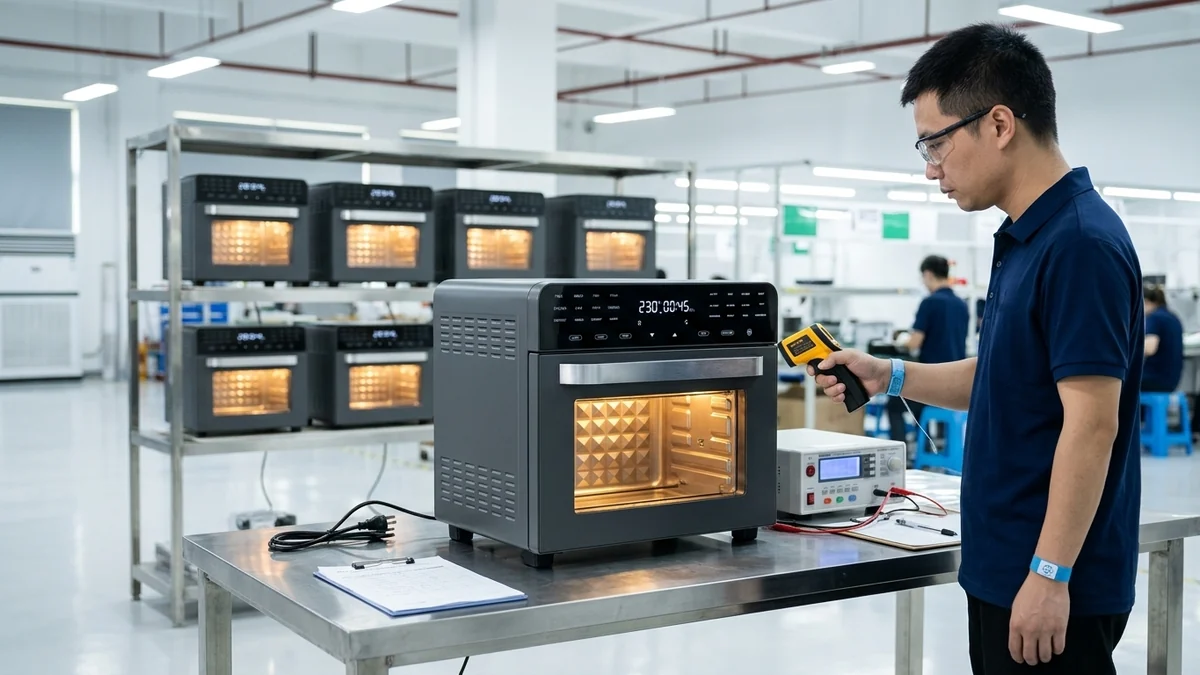
How We Test Every Air Fryer Oven: Hipot, Aging, Life-Cycle, Drop and AQL 2.5 — Our QC System Explained
A low FOB price means very little if the container comes back as returns. In a Which? survey of 8,659 air fryer owners (survey April 2025, updated 6 Nov...
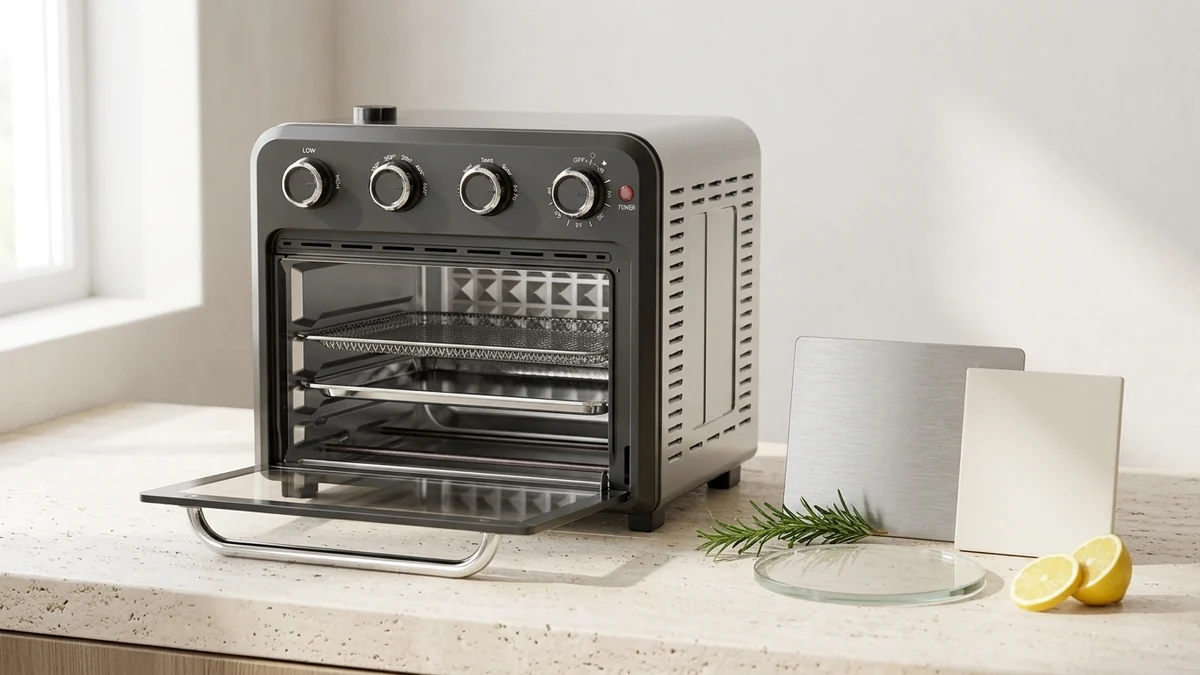
PFAS-Free, Ceramic or Glass? Food-Contact Materials for Air Fryer Ovens, Explained for Buyers
Two years ago, food-contact material was a line in the specification sheet. Today it is a listing decision. Consumer concern about non-stick coatings has...