
How We Test Every Air Fryer Oven: Hipot, Aging, Life-Cycle, Drop and AQL 2.5 — Our QC System Explained
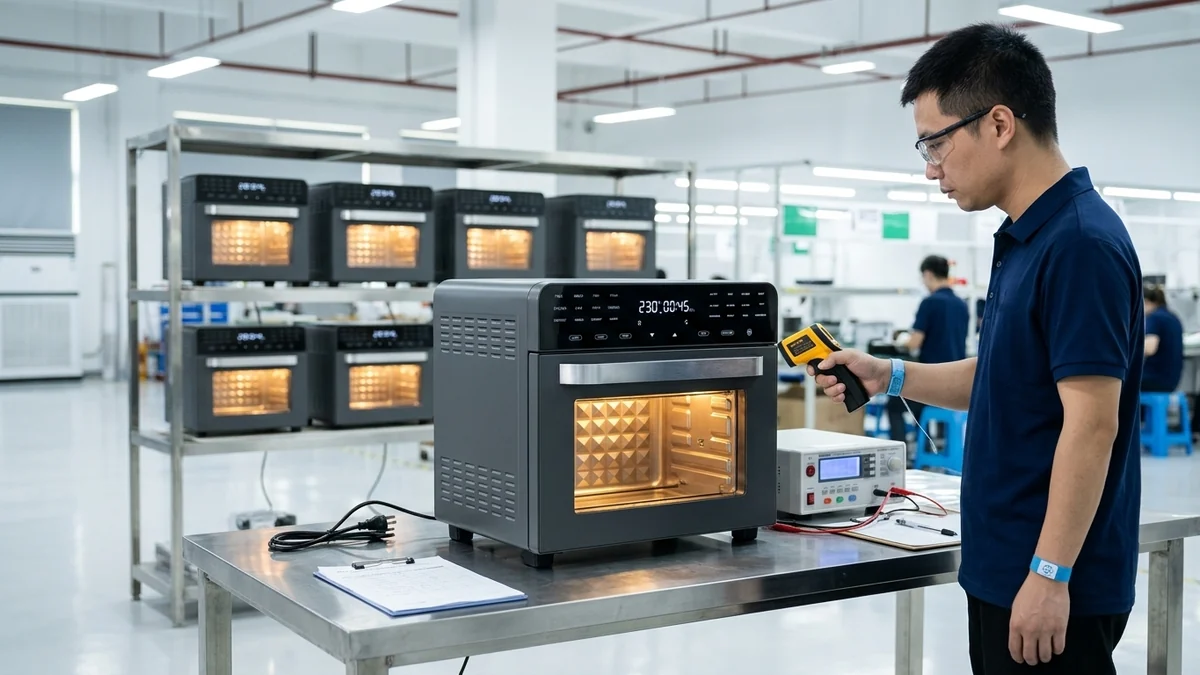
- Reliable appliance quality is gated at three stages: incoming component QC (IQC), in-process production checks (IPQC), and final pre-shipment inspection (PSI).
- Every LINDEN unit undergoes 100% high-voltage hipot safety testing and burn-in aging on the line before packaging.
- Standard export batches follow AQL 2.5 (major) / 4.0 (minor) under ISO 2859-1, with full support for SGS, Intertek, or Bureau Veritas third-party PSI.
Why QC Is Where Your Margin Is Won or Lost
A low FOB price means very little if the container comes back as returns. In a Which? survey of 8,659 air fryer owners, the most common faults among faulty units were cooking performance deteriorating (24%), the control panel stopping working (19%) and the cooking tray breaking (14%) (Which?, 2025/2026).
Review-mining by NoolaGuide (2026, directional — it is review analysis, not return data) found durability complaints were the single most damaging theme for ratings. There is no verified public category return-rate percentage for air fryer ovens, and any supplier who quotes you one without showing the data behind it should be treated with caution.
This article explains, step by step, what a complete QC system for an air fryer oven looks like — incoming inspection, in-process checks, 100% end-of-line safety tests, aging and life-cycle testing, and the AQL sampling standard your pre-shipment inspection will be judged against — so you can compare any factory, including ours, on the same checklist.
Step 1: IQC, IPQC and FQC — The Three Gates
A serious factory does not inspect quality in at the end; it gates it at three points, a structure described consistently across OEM sourcing guides.
IQC (incoming quality control): heating elements, fan motors, thermostats, control boards, coatings and glass are checked on arrival, before they can enter production.
IPQC (in-process quality control): checks during assembly — wiring and connector seating, screw torque, door alignment — catch defects while they are still cheap to fix.
FQC (final quality control): finished units are function-tested, inspected for cosmetic defects, and checked against the approved golden sample before packing.
Ask any factory to show you the checklists and the reject records for each gate, not just the flow chart. A flow chart is easy to print; a filled-in reject log is much harder to fake.
At Foshan Linden Intelligent Appliances Co., Ltd. (Linden), the three gates are staffed by a dedicated QC team working to documented checklists for each gate, incoming components are inspected before they are released to production, and key measurements are taken on calibrated test equipment. The filled-in reject logs for each gate are retained and can be reviewed with buyers during a factory visit or audit — ask us to walk you through them, gate by gate.
Step 2: The 100% End-of-Line Safety Tests — Hipot, Leakage, Earth Continuity
Some tests are sampling tests. The electrical safety tests are not: they are performed on every unit coming off the line. The benchmark figures published in OEM guides are:
| Test | What it checks | Published benchmark |
|---|---|---|
| Hipot / dielectric withstand | Insulation integrity between live parts and accessible surfaces | 1,500–3,000V for 1 minute, 100% of units |
| Leakage current | Current leaking to accessible parts in operation | Below 0.5 mA |
| Earth continuity | Protective earth path resistance | Tested at 25A |
| Thermostat accuracy | Actual cavity temperature vs set temperature | Within ±5°C |
These are not bureaucratic hurdles. The failure mode behind the largest air fryer recall in the category — the Cosori recall discussed in detail in our companion article — was an electrical connection overheating (CPSC recall 23-130, Feb 2023). Hipot, leakage and connector checks are exactly the tests designed to catch that class of defect before it ships.
On the KA1203 line at Linden, hipot, leakage-current and earth-continuity tests are run on every unit in line with the IEC 60335 series requirements behind the model's CB certification; thermostat accuracy is verified as part of the same end-of-line routine; and the test equipment is kept under a calibration schedule, with the records retained for buyer audit.
Step 3: Aging Tests and Heater / Fan Life-Cycle Testing
The faults buyers fear most — performance deteriorating, fans failing, control panels dying — do not show up in a five-minute function test. They show up after hundreds of hours. That is why aging and life-cycle testing matter:
100% aging run: OEM guides describe finished units run for 30–60 minutes before packing to catch infant-mortality failures.
Heater and fan life testing: components are run under continuous load on a sampling basis to validate service life.
Switch, dial and door life-cycle testing: controls and hinges are cycled thousands of times to simulate years of use.
One warning, taken from our own research: even a single publisher's guides disagree on fan-motor life — industry benchmarks state at least 3,000 hours for quality motors in one guide, and 500–1,000 hours under continuous load in its OEM guide. Treat both numbers as supplier claims. The correct buyer response — to us or to anyone — is: show me the life-test report for this motor, on this model.
At Linden, every finished KA1203 completes an aging run before packing, and life-cycle testing on components such as the fan motor and heating element is carried out on a sampling basis, with the reports held in the model's technical file. Ask for the current life-test report for the exact model you are buying — that report, not a number quoted in a blog post, is the document your audit should rely on.
Step 4: Coating, Materials and Abuse Tests
Beyond electrics, a complete test plan covers the parts consumers touch and heat every day:
Coating abrasion testing on baskets, crisper plates and cavity surfaces, because coating wear is both a durability and a food-contact issue.
Salt-spray testing of metal parts — OEM guides cite 24–72 hours — to validate corrosion resistance for humid markets and container shipping.
Drop testing of the packaged product — an 80 cm drop test is cited in factory QC practice — as a first screen before formal ISTA transit testing.
Food-contact verification: coating and material claims should be backed by FDA (US) or LFGB (EU) test reports for the actual materials used, not generic supplier declarations.
At Linden, coating abrasion, salt-spray and packaged drop testing form part of the model's test plan, run to the procedures set in the model's specification, with results recorded in the batch file. Food-contact compliance for the materials in your model is documented per material at project review, and the reports are supplied with the project documentation so you can verify them with the issuing laboratory.
Step 5: AQL 2.5 / 4.0 — With a Worked Example
Pre-shipment inspection is normally sampled to ISO 2859-1 at AQL 2.5 for major defects and AQL 4.0 for minor defects — the levels cited across OEM sourcing guides. AQL is widely misunderstood, so here is what it means in practice:
| Term | Meaning |
|---|---|
| Major defect | A defect that impairs function or safety, or that a retailer would reject |
| Minor defect | A small cosmetic flaw that does not affect function |
| Worked example | Under AQL 2.5, a batch of 1,000 units fails inspection if more than 10 major defects are found in the sample |
AQL is a sampling agreement, not a promise of zero defects — which is precisely why it must sit on top of the 100% line tests in Step 2, not replace them. Agree the AQL levels, the defect classification list and the sample size in the purchase order, before production starts, not at the loading dock.
Linden signs purchase orders at AQL 1.5 for major defects and AQL 4.0 for minor defects, and third-party pre-shipment inspection by a buyer-nominated agency can be arranged.
Step 6: Third-Party Pre-Shipment Inspection — How to Book It and What We Provide
Most experienced importers and retail buyers book a third-party pre-shipment inspection (PSI) through agencies such as SGS, Bureau Veritas, Intertek or TÜV — named consistently across sourcing guides. Our position should be simple: welcome it, and make it easy.
Book the inspection for when production is 100% complete and at least 80% packed — the standard PSI condition.
The inspector draws samples randomly from sealed cartons, not from units the factory selects.
You should receive the full report — photos, test records, defect list and measurements — whether the result is pass or fail.
Third-party pre-shipment inspection by a buyer-nominated agency — SGS, Bureau Veritas or Intertek — can be arranged on our lines; book through your agency in good time ahead of the planned shipment date, and our QC team will support the inspection on the day. Your QC contact at Linden is the quality team, reachable at [email protected].
Buyer Checklist: 8 Questions to Ask Any Factory (Including Us)
Do you run hipot, leakage and earth-continuity tests on 100% of units — and can I see today's line records?
What are your actual aging-test duration and life-test hours, and where is the report?
What AQL levels will you sign in the PO, and what counts as a major defect?
Can I see the last batch's FQC and PSI reports — including the failures?
How are wiring connectors seated and verified, given the category's recall history?
Which coating and food-contact test reports cover the exact materials in my model?
Do you accept my nominated inspection agency before balance payment?
What is your corrective-action process when a batch fails PSI?
Talk to Us About Your QC Requirements
If you are preparing an RFQ, send us your target market, model specification and your own QC/inspection requirements, and we will respond with how each requirement is covered in production — test by test, with the documents named.
Contact Linden at [email protected] or +86 156 2237 7841 — we reply within 8 business hours.
Ready to Spec Your OEM/ODM Air Fryer Oven Line?
Get factory FOB pricing, test certificates, and 500–1,000 unit MOQ customization options within 24 hours.
Related Sourcing Guides
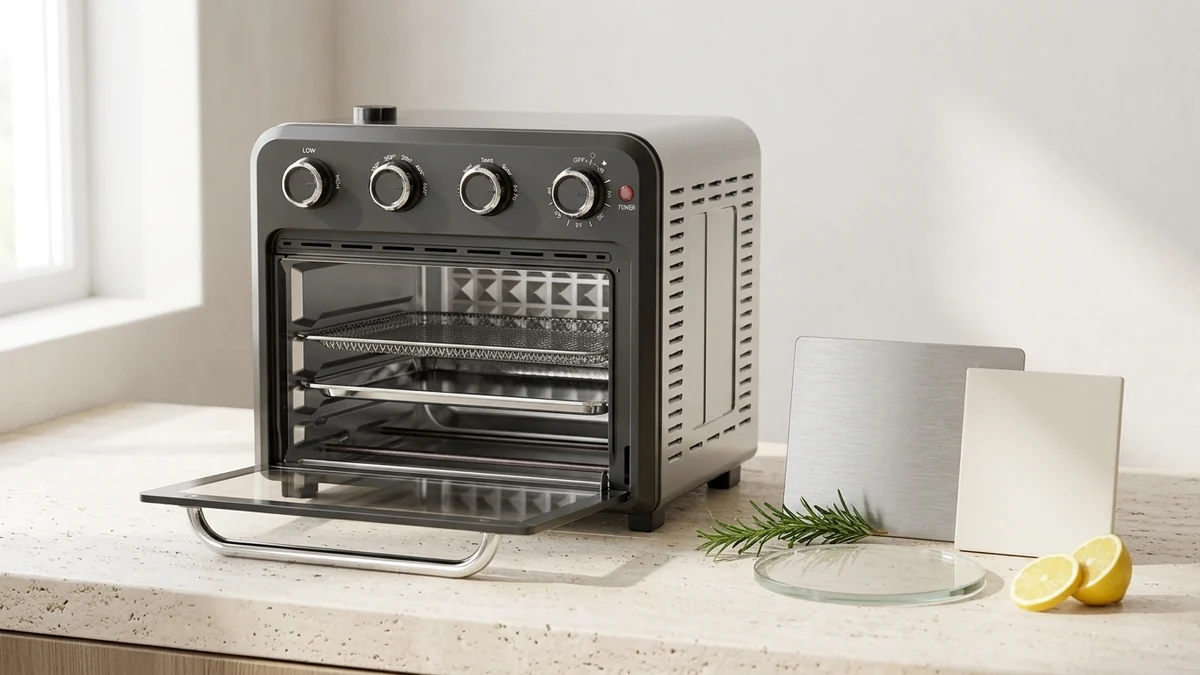
PFAS-Free, Ceramic or Glass? Food-Contact Materials for Air Fryer Ovens, Explained for Buyers
Two years ago, food-contact material was a line in the specification sheet. Today it is a listing decision. Consumer concern about non-stick coatings has...

What the Cosori and Insignia Recalls Teach B2B Buyers: 7 Safety Questions to Ask Any Air Fryer Factory
Cosori — CPSC recall 23-130, 23 Feb 2023. Around 2 million air fryers were recalled in the United States, plus roughly 250,000 in Canada and 21,000 in...