
Which Air Fryer Oven Should You Launch? Capacity & Feature Tiers Mapped to Channel (E-commerce, Retail, Premium)
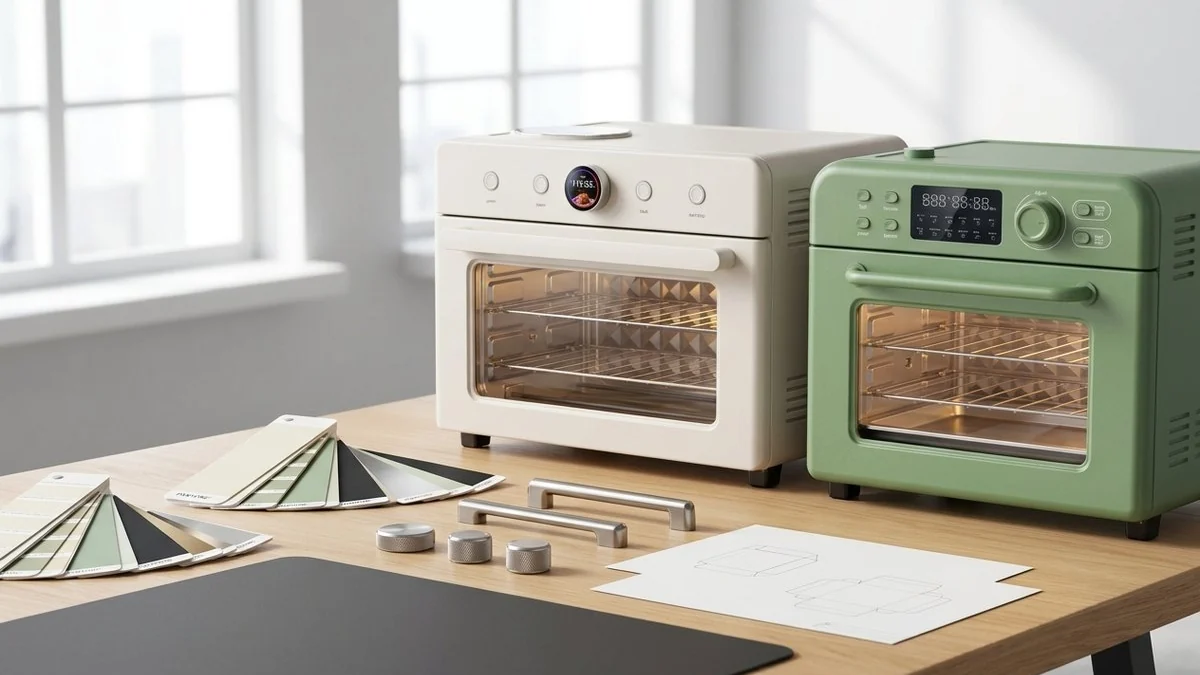
- Match oven capacity and UI complexity to channel economics: 12L mechanical models excel at entry price points; 16L IMD digital models hit the e-commerce sweet spot.
- 30L digital and TFT steam air fryer ovens command higher retail margins for flagship kitchen brands and specialty retailers.
- Start with 1–2 focused hero SKUs at 500–1,000 units MOQ before expanding into full multi-size product families.
"Which model should we launch?" is the wrong first question. The right question is: which capacity and feature tier fits my channel, my shelf price, and my returns tolerance?
A 12-liter oven that thrives as an e-commerce hero can die on a retail shelf next to a benchmark brand, and a 30-liter premium oven that wins a department-store placement will sink an Amazon listing under freight and FBA fees.
This article maps the tiers to the channels, using the market and benchmark evidence buyers themselves use — and stating the conflicts in that evidence honestly, because a launch decision built on one cherry-picked market number is a launch decision built on sand.
1. The Market Is Growing — But Quote a Range, Never One Number
Start with the uncomfortable truth about category data: published market-size estimates for air fryers conflict, because they measure different scopes (basket-only vs broader definitions, different base years and geographies).
Grand View Research figures, as summarised with matched data, put the market at $1.28B in 2023 growing to $2.07B in 2030, a 7.9% CAGR for 2024–2030, with North America at 37.6% of 2023 revenue (Source: Grand View Research figures as summarised). Market Research Future gives $1.3B in 2024 growing to $2.69B in 2035, a 6.84% CAGR (Source: Market Research Future).
Data Bridge gives $1.07B in 2024 growing to $1.89B in 2032, a 7.3% CAGR (Source: Data Bridge Market Research). The base-year estimates span $1.07B–$1.3B and the growth rates span 6.84–7.9% — directionally consistent (steady high-single-digit growth), numerically different. Present that range, with its definitions, to your board or your retail buyer; do not present one headline figure.
Two harder data points are worth more than any forecast. The International Housewares Association's MarketScope report (13 May 2026) put US home and housewares at $77.12B in 2025, with kitchen electrics up 4% and "growth was led by air fryers" on Circana data (Source: IHA MarketScope).
And a US EIA-based count puts air-fryer use at 57.93M US homes using one weekly in 2024 (Source: as summarised with GVR/EIA data). Translation for launch planning: this is a penetrated, replacement-and-upgrade market in the US, not a first-purchase gold rush — your tier must win against an installed benchmark, not against an empty kitchen.
2. Two Different Core Markets: The 5–6 Qt Basket and the 12–30L Oven
Do not let anyone sell you an oven using basket statistics, or vice versa. In the Grand View Research breakdown, up-to-4L models were 48.4% of 2023 revenue and automatic models 58.4% (Source:), while a supplier guide citing GVR describes 5–6L as the "bestselling export category" at roughly 45–55% of OEM orders — flagged as supplier-stated. That is the basket core: 5–6 Qt, one or two eaters to a small family, shelf prices anchored around $90–130 (see the benchmark table below).
The oven market is a different ladder, and factory line-ups show how suppliers themselves tier it. Linden's 2026 Canton Fair line-up organizes its range as 12L for e-commerce, 16L for family, and 30L for premium private label (Source: Linden, 2026 Autumn Canton Fair line-up).
Global Sources oven listings snapshot 12L ovens at $24.80–51, 23–24L at $40–48.50, and 25L at $25–44 at MOQs of 290–1,100 — listing prices, not transaction prices (Source: Global Sources listings snapshot, Nov 2026). Oven-style watt density also runs lower than baskets — Panda puts oven-style at 150–250 W/L versus 250–350 W/L for mainstream 4.5–6L baskets (Source: Ningbo Panda, cost-per-liter guide).
Decide which ladder you are climbing before you compare a single price.
3. The Benchmarks Your Buyer Will Measure You Against
Whatever tier you choose, someone in the buying meeting will name these anchors.
Retail price/spec benchmarks checked 24 Oct 2026 put the Ninja AF141 5 Qt at $89.99 and the Ninja AF181 6.5 Qt at $129.99, with the Breville Smart Oven Air Fryer Pro (BOV900) at $319.95 — 1 cu ft capacity fitting a 9×13-inch pan, a 13-inch pizza, or a 14-lb turkey, at 1,800W and 480°F max with 13 functions (Source: PickMetric benchmark roundup).
The Cosori TurboBlaze 6 Qt sits at $99.99 (Source: AirFryerVerdict). At the premium glass end, the Ninja Crispi 4 Qt lists at $159.99 and the Crispi Pro at $299.99 in Oct–Nov 2026 price checks (Sources: in the research report).
Your launch SKU needs a written answer to one question per tier: against this anchor, what do we offer more of — capacity, features, materials, or price headroom?
| Tier | Typical format | Benchmark anchor (source-labeled) | What the anchor teaches |
|---|---|---|---|
| Basket core | 5–6.5 Qt basket | Ninja AF141 $89.99 / AF181 $129.99; Cosori TurboBlaze 6 Qt $99.99 (PickMetric; AirFryerVerdict) | The volume fight is at $90–130; differentiation must be visible (glass, dual zone, color) |
| Oven entry | ~12L oven | Global Sources 12L listings $24.80–51 FOB (listings snapshot) | E-commerce hero tier; freight-friendly, content-friendly |
| Oven family | 16–25L oven | Global Sources 23–25L listings $25–48.50 FOB (listings snapshot) | Family/retail tier; "what fits" proof decides conversion |
| Premium oven | ~30L, French door / smart | Breville BOV900 $319.95 retail (PickMetric) | Premium is spec + brand theatre: 480°F, 13 functions, pan/pizza/turkey proof points |
Now put your own range next to those anchors. This is the current oven line-up at Linden:
| Model | Capacity | Power | Max temp | Functions | FOB @ 1,000 units | Target retail |
|---|---|---|---|---|---|---|
| KA1203 | 12L | 1,400W | 230°C | 6 | By quotation | By quotation |
| AM1601 | 16L | 1,400W | 230°C | 18 | By quotation | By quotation |
| AE3009 | 30L | 1,700W | 230°C | 8 | By quotation | By quotation |
Usable capacity is measured per model with the crisper plate fitted and is supplied in each model's measurement pack, alongside internal dimensions, "what fits" proof (pizza size, pan, whole chicken) and the standard accessory set. Judge "what fits" from the cavity dimensions of the model you are launching — check the pizza, pan or chicken against the internal width and depth in the spec, and confirm it on the physical sample before the claim goes on your packaging.
4. Feature Tiers: Mechanical, Digital, Smart — and the Two Design Stories That Sell
Features should be tiered by channel economics, not by engineering enthusiasm. Mechanical (knob) tiers minimize PCBA cost and failure points and suit price-led and emerging-market channels. Digital tiers — presets, precise temperature control, interior light, rotisserie and dehydrate — are the mainstream oven offer; a typical oven line runs to 230°C max where basket lines typically run 80–200°C. Smart/app tiers add a supplier-stated $3–6 per unit plus app investment, and raise an ownership question — whose app account and firmware keys, and who maintains OTA updates — that must be settled before launch.
Two design stories currently carry premium tiers. First, dual-zone / stacked formats, shown across IFA 2025 launches such as Midea's dual-zone 11 Qt and Dreame's Tasti 11L dual-zone (Source: IFA 2025 coverage).
Second, glass and PFAS-free construction: CHOICE documents glass-basket growth driven by PFAS-free positioning, while warning that crisper plates may still be coated (Source: CHOICE); SOKANY showed a 6L borosilicate-glass PFAS-free fryer at the 140th Canton Fair in Oct 2026 (Source: SOKANY Canton Fair release), and Lotus led its Inspired Home Show 2026 oven with a "PFAS-free nonstick interior" at an $899.95 SRP (Source: HomePage News).
Both stories are powerful — and both carry IP and claim-substantiation duties covered elsewhere in this series.
5. Mapping Tier to Channel
| Channel | Tier that fits | Why | |
|---|---|---|---|
| Amazon / DTC e-commerce | 12L oven hero, or differentiated 5–6 Qt (glass, dual-zone) | Content and reviews reward a visible difference; carton size and FBA economics punish oversize — industry engineering benchmarks, digital tier | Shelf comparison is against Ninja/Cosori anchors at $90–130 basket and family-oven price points; packaging, audits and warranty decide listing (Sources:) |
| Department store / premium retail | ~30L premium oven, French door, smart or glass story | Breville's $319.95 anchor proves headroom for spec-led premium (Source:) | |
| Emerging-market distribution | Mechanical / simple digital, voltage-correct versions | Price sensitivity and service simplicity outweigh app features; version and plug discipline matters more than presets |
Applied to our own range as a recommendation rather than a rule: the KA1203's freight-friendly 12L format suits e-commerce sellers; the AM1601's 16L family format suits retail importers who need a "what fits" story on the shelf; and the AE3009's 30L format suits premium private-label programs — in each case at an MOQ is 500–1,000 units per model. Use that pattern — one hero model per channel — rather than launching the whole range everywhere at once.
6. A Launch-SKU Recommendation Framework
Score each candidate SKU 1–5 on six tests before you commit tooling or a first container: (1) Anchor gap — is there clear air between you and the benchmark on price, capacity, or materials? (2) Proof in one photo — can "what fits" (pizza, pan, whole chicken) be shown in a single image with real internal dimensions? (3) Landed margin at tier FOB — using supplier-stated oven benchmarks only as a sanity range (12L oven $30–40 FOB at 1,000 units, Panda), does your channel margin survive freight, duty, and platform fees? (4) Returns exposure — the commonest faults in the Which? owner survey (n=8,659) are deteriorating performance (24% of faulty units), control panels (19%), and trays (14%) (Source: Which?); does this tier's design attack those three? (5) Claim safety — can every PFAS-free / capacity / temperature claim be evidenced per part and per test? (6) Second-order life — are spare trays, racks, and parts orderable in year two, so the SKU can become a range, not a one-off?
Launch the SKU that scores well on all six, in one channel first — then extend.
Our own current recommendation for a first launch is the AM1601, positioned for Amazon and DTC e-commerce with retail pricing confirmed by quotation, an MOQ is 500–1,000 units per model and a 45-day mass-production lead time. Against the Ninja AF181 anchor, the AM1601 differentiates on usable oven capacity and family-size "what fits" proof rather than trying to win a basket price war — the pattern the framework above is designed to produce.
Buyer FAQ
Is bigger always better for ovens? No. Oven tiers exist because channels differ: 12L is the e-commerce tier and ~30L the premium private-label tier in factory line-ups (Source: Linden). Oversize hurts freight and FBA economics.
Should I launch a basket or an oven first? They are different ladders with different price anchors ($90–130 basket core vs oven FOB tiers) (Sources:). Choose by your channel, not by category headlines.
Can I trust the market-growth slide in a supplier deck? Only if it names its source and scope. Published estimates range from $1.07B to $1.3B base-year with 6.84–7.9% CAGRs (Sources:) — ask which definition any deck is using.
Get a Tier Recommendation for Your Channel
Tell us your channel, target market, and the shelf price you must hit, and we will map the tier — capacity, feature set, and version — that fits, with the benchmark it has to beat. Contact Linden at [email protected] or +86 156 2237 7841 — sample orders for the KA1203 ship within 7–15 days (planning range for samples and trial orders), and we reply to tier and quotation enquiries within 8 business hours.
Ready to Spec Your OEM/ODM Air Fryer Oven Line?
Get factory FOB pricing, test certificates, and 500–1,000 unit MOQ customization options within 24 hours.
Related Sourcing Guides
From RFQ to Container: Lead Times, Peak-Season Planning, Payment Terms and Inspection — The Complete Order Timeline
Most first-order disasters are not product failures. They are timeline failures: an RFQ so vague that three factories quote three different products...

Air Fryer Oven Certifications by Market: ETL/UL 1026, CE, UKCA, RCM — What Your Exact Model Must Have
If you import, distribute or list countertop air fryer ovens, certification is not a paperwork detail at the end of the deal — it is the first filter your...