
2026 Air Fryer Oven OEM / ODM Sourcing Guide

Contents
- Confirm destination-market electrical builds (120V/60Hz for North America vs. 220–240V/50Hz for EU/UK/AU) and exact model certificates before artwork.
- Standard OEM/ODM orders at LINDEN start at 500–1,000 units per model with a 45-day FOB mass-production lead time from our Foshan plant.
- Always sign off a golden pre-production sample covering color swatch, silkscreen artwork, accessories, and drop-tested packaging before mass production.
How to spec, sample, and source a countertop air fryer oven that actually sells in your market — without paying for mistakes that could have been caught on paper. Written for importers, private-label brands, and retailers · Updated for 2026.
Quick Answer
Choose your path based on your risk profile: private label for speed, ODM for differentiation, and full OEM only when you truly need a ground-up design. Lock your specs in writing before comparing quotes — capacity, voltage, functions, materials, and accessories. Then test the sample the way your customers will use it, and verify certifications for your exact model and target market.
LINDEN's terms are straightforward: 500–1,000 unit MOQ, 45-day mass production lead time, FOB pricing, with deposit and balance terms negotiated per order. Sample fees and sample lead times are agreed per project, as are timelines and costs for custom colors, control panels, or doors. Whoever pays for tooling owns the mold. These are baseline terms — exact figures for your order belong in a written quote, as a custom panel or new door changes the scope of work.
Who This Guide Is For
Importers need clean documentation and shipments that match the agreement. Private-label brands need a product that stands out in thumbnails and holds up in reviews. Retail buyers need steady supply and pricing that still works after freight. All three make remarkably similar mistakes — under-specified quotes, rushed samples, certificates tied to the wrong model — and all of them are avoidable if you ask early.
OEM, ODM, or Private Label: Which Path Fits Your Brand?
The difference isn't quality tier. It's how much you modify, who owns the design, and how much tooling capital you put at risk.
| Directions | What It Means | Best For | Note |
|---|---|---|---|
| Private Label | Proven base models finished with your brand logo and retail packaging | Market testing, first order, tight launch deadline | Competitors may sell the same product |
| ODM | Proven models co-customized with you: control panel, functions, finishes, and accessories | Most brands — distinct look without new tooling costs | Put in writing which modifications belong exclusively to you |
| OEM | Built to your design, typically requiring new tooling | Buyers with engineering drawings, proven volume, and development lead time | Longest timeline; tooling cost and ownership must be defined by contract |
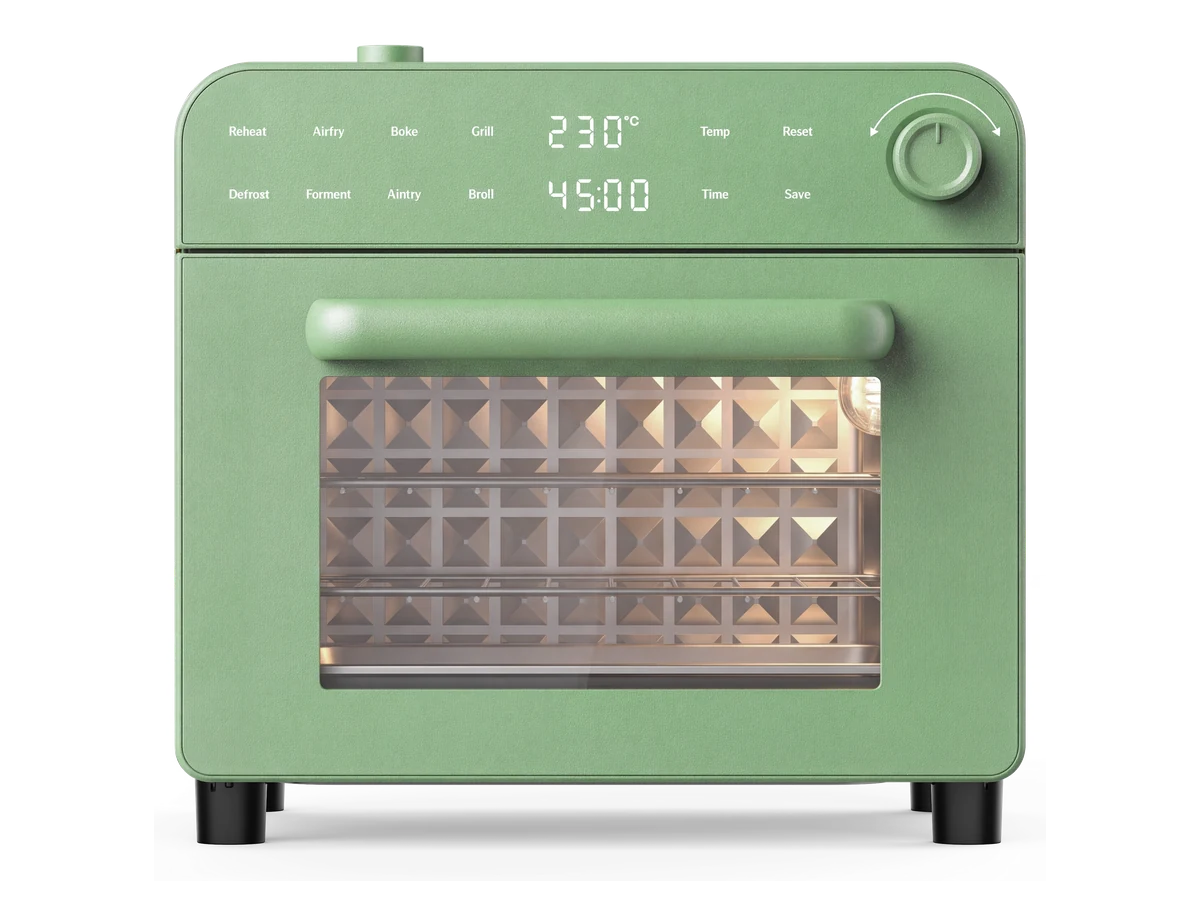
Most buyers land in the middle: a proven base model — the 16L AE1606 or the 30L AE3007/AE3009 — updated with a new control panel, function set, surface finish, and retail box. It looks like your product without betting your launch on an unproven design.
About LINDEN
LINDEN is Foshan Linden Intelligent Appliances Co., Ltd., founded in 2021 in Foshan, China. Operating from a 15,000 m² facility with 3 assembly lines, 100+ employees, and 50+ patents, we manufacture 12L, 16L, and 30L air fryer ovens and food dehydrators. Our products reach 110+ countries through 200+ brand partners. Contact: [email protected], Tel: 15622377841, www.foslinden.com.
The Sourcing Process, in Seven Steps
Every good factory runs some version of this sequence. If a supplier jumps straight from a chat message to asking for a deposit, slow the pace down.
- Send a complete inquiry.Model, quantity, target market, and what you want to customize. Use the RFQ template at the end of this guide — vague inquiries only get vague quotes.
- Lock the specification sheet.Capacity, voltage, functions, materials, controls, accessories, and packaging documented in a single mutually signed spec sheet. If it isn't on the spec sheet, it isn't agreed.
- Get a written quotation.Unit price by order tier, sample cost, any tooling charges, packaging specs, and what is excluded. Always ask what variables could change the quoted price.
- Test a real sample.Built to your specs, your voltage, and your control panel. Cook with it, run the rotisserie, and clean it — that's where hidden flaws show up.
- Verify testing and certifications.Match every certificate and test report to the exact model number, voltage, and factory before production starts.
- Approve the pre-production sample.The final approved sample held as the benchmark for mass production. Keep at least signed reference photos.
- Production, inspection, and shipment.Agree on inspection standards upfront: what is checked, how many units are sampled, and what counts as a defect. Confirm carton markings and shipping terms in writing.
Structure payment milestones around these stages and treat sample approval as a real gate rather than a formality. LINDEN ships FOB with deposit and balance terms negotiated per order, and a 45-day mass production lead time after sample approval.
Lock in these specs before you ask for a quote
Two factories quoting "a 30L air fryer oven" may be pricing very different machines. Lock down these details first.
Capacity & Dimensions
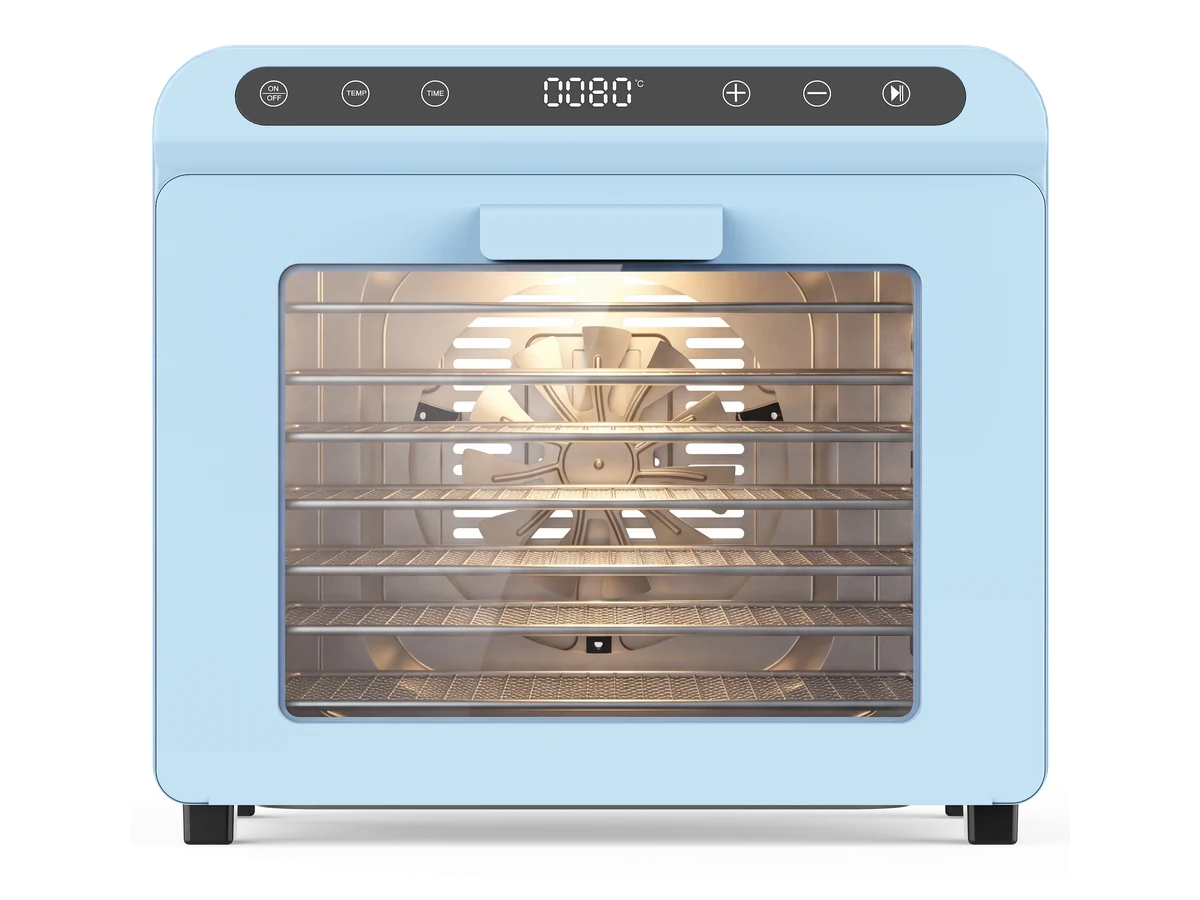
LINDEN's lineup spans 12L, 16L, and 30L. Ask for exterior dimensions and usable cavity dimensions rather than relying on nominal liters alone — along with the questions customers actually care about: will it fit a whole chicken or a standard pizza? The AE3007 measures 428 × 400.8 × 389.6 mm, and the AE3009 measures 428 × 406 × 334 mm.
Voltage, Plug, and Wattage — Get the Market Right First
The costliest mistake here is also the simplest. The US uses 120V; most of Europe runs on 220–240V. Switching markets isn't just changing a plug — heating elements, controls, testing, and certifications all change with it. Name the destination country first, then confirm voltage, plug, and wattage.
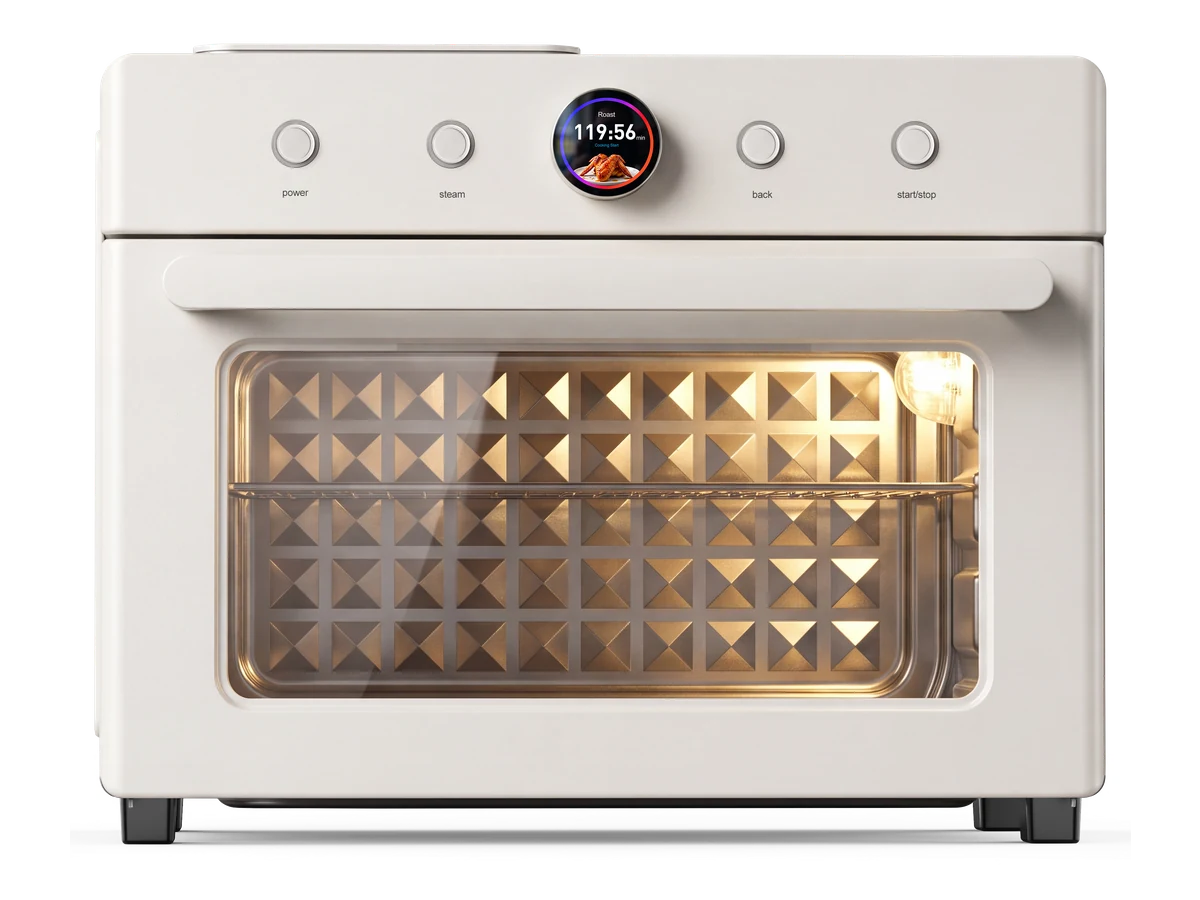
The AE3009 features a dual-voltage design — 120V/60Hz and 220–240V, 50/60Hz — so US and EU versions share the same platform with separate specifications. The AE1606 is 220–240V, 50/60Hz; the AE3007 is 230V, 50Hz. Selling in both markets? Price them as two separate SKUs.
Functions & Controls
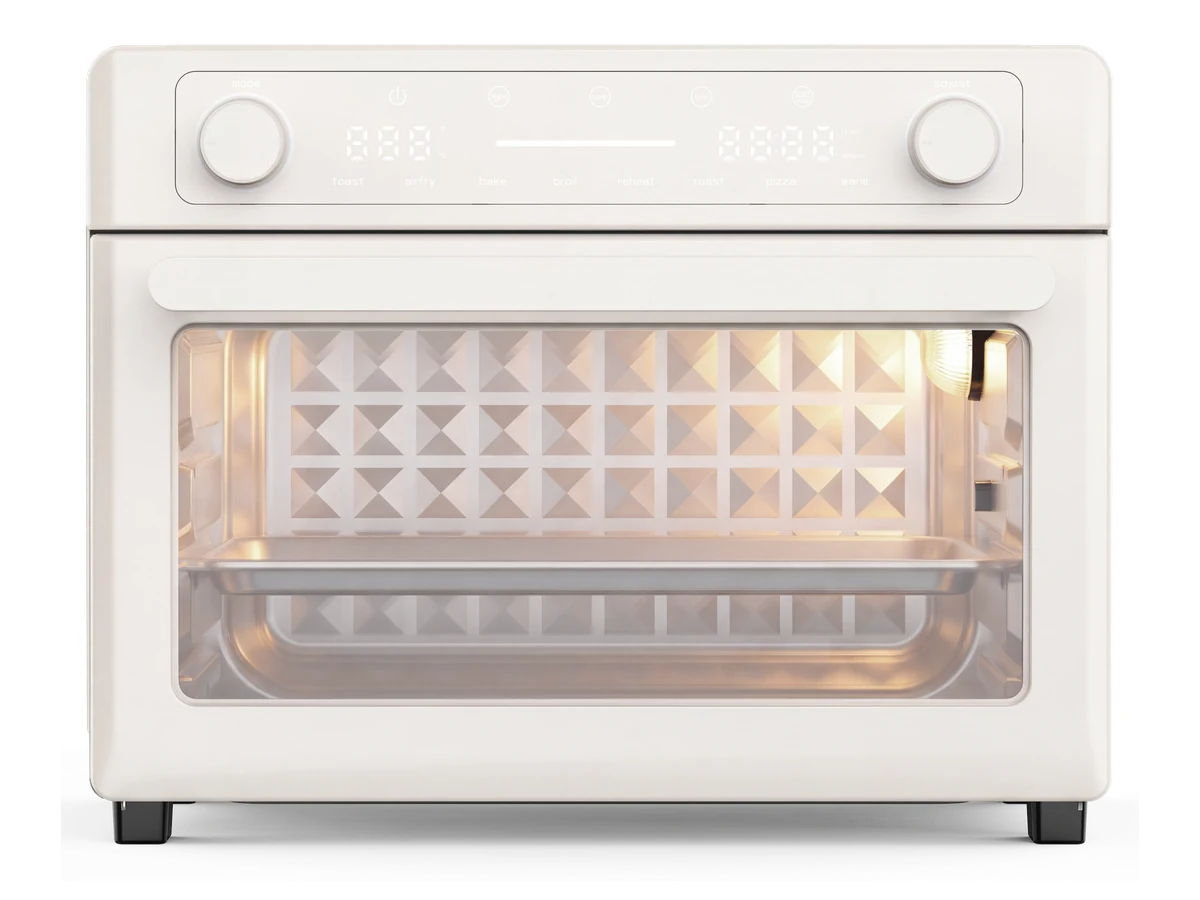
Write down your exact function list in order. LINDEN's AE3009 has eight functions — Toast, Air Fry, Bake, Broil, Reheat, Roast, Pizza, Warm; AE1606 also has eight: Reheat, Air Fry, Bake, Grill, Defrost, Ferment, Dehydrate, Cook. AE3007 adds nine presets and seven steam-assisted modes. Never assume a factory's "eight functions" match your eight. Check the sample display word for word against your list. Then pick your control interface: knobs photograph well, touch panels look cleaner, and color screens cost more.
Materials, Non-Stick Coatings & PFAS-Free Compliance
More buyers are asking for PFAS-free cooking surfaces as consumer interest in "non-toxic air fryers" grows. If this is part of your positioning, define it precisely first: do you mean the bakeware coating, the inner cavity, or every food-contact component? Secure the food-contact test documentation for your target market, and do not print "PFAS-free" on the box until the paperwork backs up the claim.
Accessories & Packaging
List everything in the box: baking tray, wire rack, air fry basket, drip tray, rotisserie spit assembly, user manual, and quick-start card. The AE3009 includes a 352 × 300 mm wire rack, a 352 × 300 × 17 mm air fry basket, an enamel baking tray, a drip tray, and a rotisserie spit set.
The AE3007 includes a drip tray, baking tray, air fry basket, wire rack, rotisserie spit and cage, 8 skewers, and more. Rotisserie sells well; its weak point is cleaning. Finally, lock in the retail gift box, master carton, and drop-test standards — a crushed corner costs far more than thicker cardboard.
US & EU Certifications
Certification is not a logo printed on a box. It is the testing your exact product passes for the market where you sell it. The table below is a starting checklist and not legal advice; when importing for the first time, confirm current requirements with the factory as well as your customs broker or testing lab.
| Market | Best For | What to Request |
|---|---|---|
| United States | Safety listing via UL or ETL; FCC rules for models with electronic or wireless controls; FDA food-contact compliance | Listing and report numbers — verify against your exact model and voltage |
| European Union | CE mark (LVD, EMC); EN 60335-2-9 — the household appliance standard commonly cited for this product category; RoHS; LFGB (Germany); GS (German voluntary safety mark) | Declaration of Conformity, complete with test reports and issuing laboratory |
| Confirmed LINDEN Certifications | Company-wide certifications: CE, CB, ETL, FDA, LFGB, ROHS. By model: AE3009 — CB/CE/ETL; AE3007 — CE; AE1606 — confirmed by model and voltage | Certificate numbers and issuing labs confirmed by model upon request — ask for the full test report, not just the certificate |
Two habits will protect your brand. Never accept a certificate image without the underlying test report — verify the model number, applicant name, and issue date yourself. And remember that hardware changes can reopen a certification file: swapping a heating element or control board can take your product outside the scope of coverage. Always ask in writing whether your customizations affect existing certifications.
MOQs, samples, lead times, and what actually drives your unit cost
Every buyer starts with the same three questions: what is the MOQ, how much is a sample, and when does it ship? LINDEN's answer is straightforward: 500–1,000 unit MOQ, 45-day mass production lead time, FOB. Deposit and balance terms are negotiated per order, as are sample fees and sample lead times. Custom colors, control panels, and doors are quoted by project — timeline and cost by agreement. Whoever pays for the tooling owns the tooling. Below are the factors that move those numbers.
- Our minimum order quantity is 500–1,000 units.Off-the-shelf models in standard colors start here; custom colors, new control panels, or printed retail gift boxes are quoted per modification — paint batches, component orders, and carton printing each carry their own minimums. Ask for the "MOQ per change," not just the MOQ per model.
- A sample costs more than the per-unit production price — someone has to build and pack a single unit to your exact specifications. Sample cost and lead time are agreed per project. Logo and color samples turn around quickly; a new door or viewing window requires engineering time and sometimes tooling. Pay for the sample. A free sample is usually an off-the-shelf unit that tells you very little about your custom run.
- 45-day mass production after sample approval.Sample lead time is agreed per project. Both sample and production timelines can stretch with new components, artwork approvals, or certification tests added midstream. Ask for both dates in your quote, and ask what they depend on.
- Unit price varies with materials, capacity, display type, accessories, packaging, and order volume.The lowest quote usually trims one of these specs behind the scenes. Compare every supplier line by line against the exact same spec sheet — otherwise you are not comparing the same product.
So instead of asking "What is your MOQ?", ask: "For this model, in this color, with this control panel and packaging, at 500–1,000 units and higher tiers — what are the unit price, sample cost, and timeline?" You will get numbers you can actually plan around, and you will learn a lot from how a factory answers. At LINDEN, start from 500–1,000 units and 45 days, then ask how your specific changes affect both.
15-Point Factory Audit Checklist
Score every serious factory against the same fifteen checkpoints. "Yes," "No," or "Show me" is all you need — and the last answer is the one that counts.
| # | Checkpoint | Answer / Evidence |
|---|---|---|
| 1 | They can name exact current models, capacities, and voltages — rather than handing you a generic catalog | |
| 2 | They quote line by line against your written spec sheet | |
| 3 | They build for your market's exact voltage and plug type — and can clearly explain what changes in that build | |
| 4 | Certificates and test reports match your exact model number, voltage, and manufacturing facility | |
| 5 | They confirm in writing whether your customizations affect existing certifications | |
| 6 | Samples built to your target specifications, voltage, and control panel artwork | |
| 7 | They inspect the sample against your spec sheet before shipping it out | |
| 8 | They can show recent sample inspection reports | |
| 9 | Clear defect criteria: what counts as a failure and how it is handled | |
| 10 | The signed golden sample is retained as the production benchmark | |
| 11 | Tooling and design ownership agreed in writing upfront | |
| 12 | Packaging, drop tests, carton markings, and pallet layout confirmed in writing | |
| 13 | Payment milestones tied to verifiable production and inspection checkpoints, not calendar dates alone | |
| 14 | Spare parts and after-sales support spelled out clearly | |
| 15 | You have a named point of contact who answers when issues come up |
You don't need fifteen perfect answers — you need honest ones, backed by paperwork on certifications, QC inspections, and tooling ownership.
Red flags worth walking away from
- A certificate without its full test report, or a report listing a different model number or voltage.
- One flat low price across every market and spec. A 120V US unit and a 230V EU unit do not cost the same to build and test; a quote that ignores the difference hasn't done the homework.
- No sample offered, or pressure to skip sampling. If you cannot test the exact build before production, your customers will test it for you.
- Vague answers on tooling and design ownership. Put it in writing before any money moves.
- A "PFAS-free" claim with no named materials and no food-contact documentation behind it.
- A timeline with no prerequisites. A real schedule spells out what it needs from you and when. A bare date on a quote is just a wish.
None of these prove a factory is dishonest. They simply mean risk is quietly being handed over to you. A good manufacturing partner moves that risk back into written specs, approved samples, and verified paperwork — before mass production starts.
Ready-to-Use RFQ Template
Copy this table into an email, fill it out, and send the exact same version to every factory. Same questions, same order — that is what makes the answers comparable. Write "TBC" where you aren't sure; don't guess.
| Field | Your Answer |
|---|---|
| Your Company | [Name, Country, Channel: Amazon / Retail / Distribution] |
| Product Type | [Air Fryer Oven / Steam Oven / Dehydrator] |
| Reference Models | AE1606(16L)/ AE3007(30L)/ AE3009(30L) |
| Capacity | 12L / 16L / 30L |
| Target Market | [Country — determines voltage, plug type, and required certifications] |
| Voltage / Plug / Wattage | AE3009: 120V/60Hz or 220–240V; AE1606: 220–240V; AE3007: 230V |
| Target Functions | AE3009: Toast, Air Fry, Bake, Broil, Reheat, Roast, Pizza, Keep Warm — or your custom list, in order |
| Door & Controls | [Single door / French double door; knobs / touch / display] |
| Materials & Coatings | [Finish & color; cavity/tray materials; note any PFAS-free requirements] |
| In the Box | AE3009: 352×300 mm wire rack, air fry basket, enamel baking pan, crumb/drip tray, rotisserie spit set |
| Branding & Packaging | [Logo finish, panel artwork, retail gift box, master carton, palletizing] |
| Quantity | First order — 500–1,000 units minimum; estimated repeat order volume |
| Sample Request | Sample fee & lead time to be agreed; build sample to this spec? Yes / No |
| Required Certifications | AE3009: CB/CE/ETL; AE3007: CE; AE1606: confirm by variant — match the marks required for your target market |
| Target Timeline | 45-day mass production after sample approval; target sample arrival date; target first shipment date |
| Ask the Factory | Pricing at 500–1,000 units and higher tiers; sample cost and lead time; MOQ per customization; tooling cost and ownership — whoever pays owns the mold |
FAQ
Do I need my own design to start an OEM or ODM project?
No. Most buyers start from one of our proven production models and customize the branding, colorway, control panel, functions, and packaging. If you have drawings, bring them — our engineers will tell you what is feasible. Building on a mature platform is faster and carries far lower risk.
What is the difference between OEM and private label?
Private labeling puts your brand on an existing product. OEM and ODM change the product itself — most ODM involves targeted adaptations, while full OEM involves major engineering. The more you change, the longer the timeline and the higher the MOQ.
How much does a custom air fryer oven cost?
It depends on capacity, materials, display, accessories, packaging, and volume — which is why no honest guide quotes a single number without a spec. LINDEN's MOQ is 500–1,000 units with a 45-day mass production lead time; unit pricing depends on the specification. Send the RFQ template at two quantity tiers and compare the line-item breakdown, not just the bottom line. The cheapest total often leaves something out.
How long does a custom sample take?
At LINDEN, sample fees and sample lead times are set per project. Color, logo, and panel artwork changes sit on the fast end. New doors, windows, or structural parts take longer and may require new tooling and a second sample round — and whoever pays for the tooling owns it. Get the sample date in writing on the quote, and ask what it depends on — artwork sign-off is a common prerequisite.
Can one model be sold in both the US and Europe?
Treat them as two separate SKUs. A 120V US version and a 220–240V EU version differ in voltage, plug, heating element design, testing, and certification. The AE3009 is dual-voltage and covers both markets, though specs, pricing, and certifications are still finalized per market. Many brands run both.
Do I handle certifications or does the factory?
Typically both sides share the work. The factory provides the test reports and technical documentation for the base model; you — often working with your customs broker or testing lab — verify that they meet your target market and retailer requirements. Put responsibilities in writing, and verify that the reports reference your exact model number.
What should we inspect on a sample before approving mass production?
Cook real food — don't just run a power-on test. Run every function against your checklist, proofread the display text character by character, test the rotisserie under load, and wash every accessory. Put all revision feedback in writing.
What should I include in my first inquiry?
More than you might think: the base model you have in mind, panel artwork or a reference photo of the layout you like, your logo files, and packaging examples you admire. Clear visual references prevent the classic sourcing mistake — where the factory builds what you said instead of what you meant.
Next Step: Send Your RFQ
You don't need a finished spec sheet — just a candidate model, a target market, an estimated volume, and a short list of changes. Fill in the template above, leave "TBC" where needed, and send it through our inquiry page. LINDEN's baseline terms are a 500–1,000 unit MOQ, 45-day mass-production lead time, FOB shipping, with deposit and balance agreed per order. We will reply with what can be confirmed for that model: specifications, customization options, and the next steps toward a sample.
Prefer to browse first? Our Products page lists all models ready for OEM and private-label orders, and the OEM/ODM page shows everything you can customize.
Get a Quote:(www.foslinden.com) · Email: [email protected] · Tel: 15622377841
Sources & Further Reading
Reference sources consulted. Claims regarding MOQs, pricing, and lead times are their own, not ours — verify every figure against your own specification.
- Yinyu Factory — Air Fryer vs Oven: Which Is Better?:https://www.yinyufactory.com/news/industry-news/air-fryer-vs-oven-which-is-better.html
- Linden — How Does an Air Fryer Oven Work?:https://www.lindenoven.com/how-does-an-air-fryer-oven-work/
- Alibaba Seller Blog — Southeast Asia Air Fryer Oven Export Strategy White Paper (2026):https://seller.alibaba.com/blogs/2026/southeast-asia/air-fryer-oven/export-strategy-white-paper
You May Also Be Interested In

How Does an Air Fryer Oven Work? A Buying Guide
Heating elements, fan speed and cavity design — the factors that actually decide cooking results, explained for buying teams.
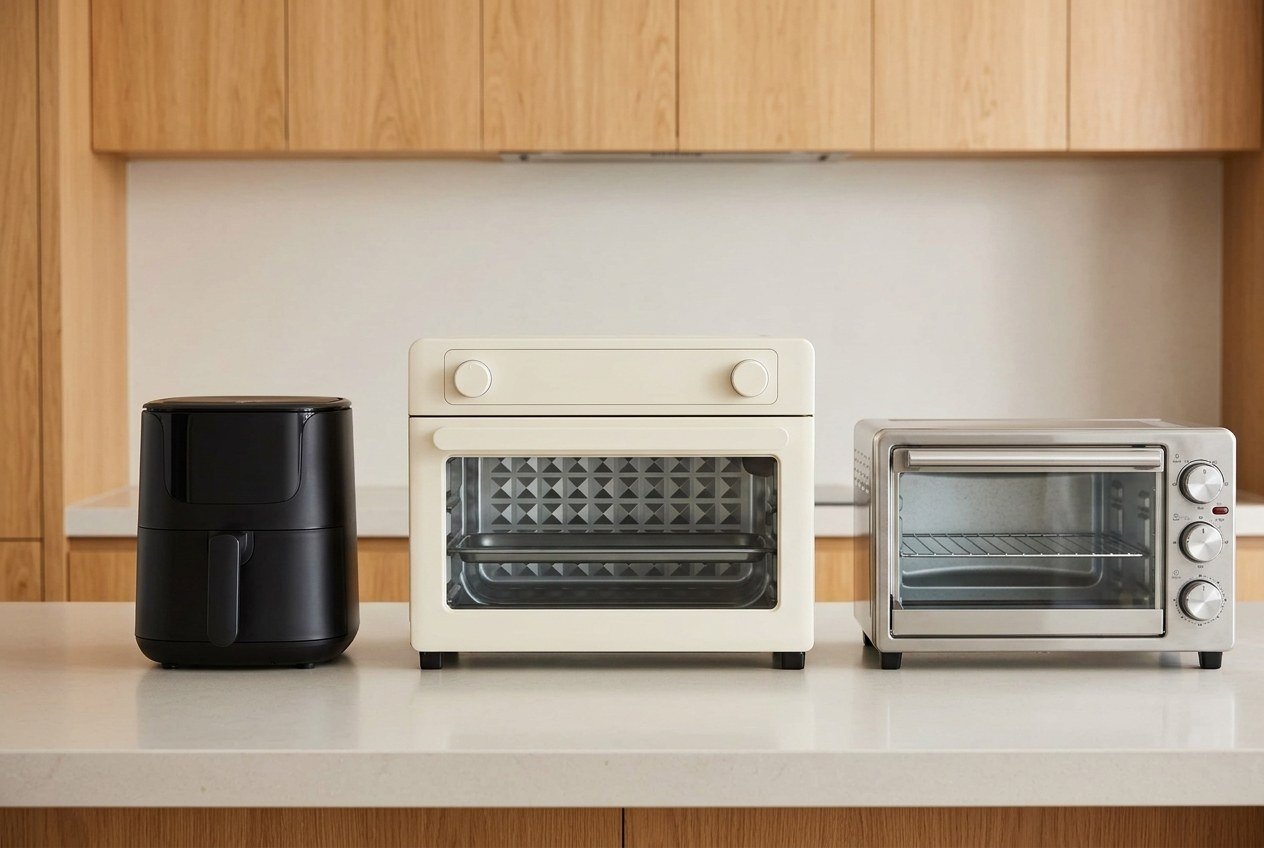
Air Fryer Oven vs. Air Fryer vs. Convection Oven
Capacity, energy use and price positioning compared side by side — so you can plan your line with the real trade-offs in view.